
When you turn a cosmetic around and start reading the ingredient list, it is very easy to give the order more meaning than it actually has. Ingredients near the top look important, those near the bottom seem less relevant, and anything with a long chemical name can attract attention simply because it is unfamiliar. That way of reading a label is understandable, but it doesn’t take you very far. The list becomes much more useful when it is read together with the product itself, because a cleanser, a moisturising cream, a lipstick and a sunscreen are all trying to do different jobs, and their formulas reflect that.
Take a facial cleanser. It needs ingredients that help loosen sebum, sunscreen, make-up and whatever else has accumulated on the skin, so the surfactant system deserves quite a lot of attention. A moisturizer has another problem to solve. It has to provide a usable base, help reduce water loss, spread comfortably and remain stable in the jar or pump, which is why humectants, emollients, occlusive materials and the ingredients holding the emulsion together start to matter. Lipstick takes us somewhere else again, because oils, waxes, pigments and structural materials have to produce something solid enough to stay in the tube but soft enough to spread and leave an even layer of color.
That sort of context often tells you more than memorising individual ingredient names.
The label still leaves a lot unsaid. For a start, you usually can’t see the exact concentration of most ingredients, and the ingredient list won’t tell you which grade of a raw material was used, what the finished pH measured after manufacture, how the phases were heated and combined, what happened during stability testing or how the preservative system performed in a microbiological challenge test. Someone with a diagnosed contact allergy may not need any of that information if the immediate question is simply whether a particular name appears on the label. Someone trying to work out whether a serum contains 2% or 5% niacinamide has a much harder problem.
Start with the product in front of you
Looking at the product category first helps avoid one of the most common mistakes in ingredient reading, which is assuming that every ingredient has the same importance wherever it appears. In a cleanser, the combination of surfactants and the way they have been balanced against one another can matter far more than a botanical extract sitting close to the end of the list. In a moisturising cream, the water phase, the humectants, the emollient system and the structure of the emulsion tell you much more about the basic construction of the product. A conditioner brings another set of priorities because fatty alcohols, cationic conditioning agents, silicones and deposition aids can all influence softness, combability and the way ingredients remain on the hair after rinsing.
The same ingredient can also be doing more than one job. Glycerin is widely recognized as a humectant, but it can influence the physical behaviour of the formula as well. Cetearyl alcohol may contribute to emollience, viscosity and the structure of an emulsion at the same time. Citric acid is another good example. Seeing it on a label does not automatically indicate an exfoliating product, since a small amount may have been added during pH adjustment.
Some of the ingredients that look least exciting on paper are doing a surprising amount of practical work. A polymer may stop a serum from running like water, an emulsifier may keep the oil and water phases from separating during storage, and a chelating agent can help manage metal ions that might otherwise interfere with stability or preservation. Small amounts of acid or alkali may be used to bring the product into the required pH range. Preservatives can sit fairly low on the ingredient list and still be essential to a water-based formula that has to remain microbiologically safe while it is being stored and used. None of these ingredients needs to be the star of the marketing campaign to matter.
What INCI means on a cosmetic label
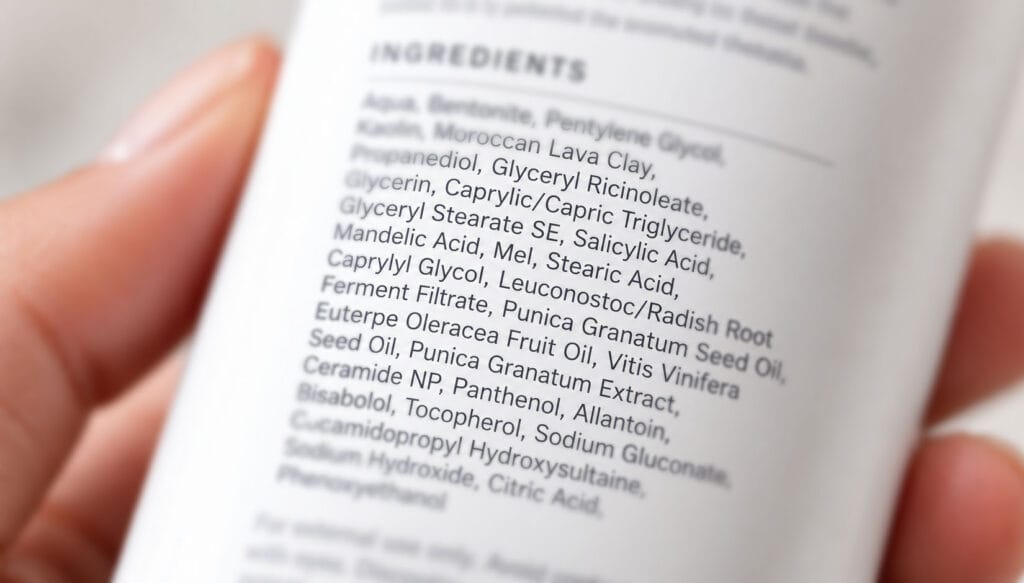
INCI refers to the International Nomenclature Cosmetic Ingredient system, the naming system used to identify cosmetic ingredients in a standardised way. The Personal Care Products Council describes INCI names as systematic names developed for cosmetic labeling, although assigning an INCI name is separate from deciding whether an ingredient can legally be used in a particular product or market.1
Within the European Union, the common ingredient glossary used for cosmetic labeling takes internationally recognized nomenclatures such as INCI into account, while the legal status of an ingredient still depends on the Cosmetics Regulation and its annexes.2 The United States uses FDA labeling rules and a separate legal framework, which is why an ingredient declaration prepared for the US market may look slightly different from the European version even when the products are closely related.3
For everyday label reading, it helps to think of the INCI name as an identifier. From there, you can look up the ingredient and start asking better questions about its usual functions, the type of formulation in which it appears and any restrictions that apply to its use. Familiarity with the word itself isn’t especially informative. Dimethicone may sound more technical than shea butter, yet the botanical material behind Butyrospermum Parkii Butter is chemically complex in its own right, and both names still leave a great deal to be learned about the particular raw material that went into the finished product.
Why ingredient names can look so different
A cosmetic label brings several naming traditions into a surprisingly small space. Some names are immediately recognisable, others come from chemical nomenclature, plant-derived materials often use botanical terminology, and colourants may be identified through the Colour Index. The result can look inconsistent when you first meet it, especially if a familiar word such as glycerin appears beside something like Butyrospermum Parkii Butter or CI 77491.
| Label name | What it identifies |
|---|---|
| Aqua | Water |
| Glycerin | A widely used humectant |
| Niacinamide | A form of vitamin B3 |
| Cetearyl Alcohol | A fatty alcohol used in many emulsions |
| Dimethicone | A silicone polymer |
| Carbomer | A polymer commonly used to control viscosity |
| Butyrospermum Parkii Butter | Shea butter |
| CI 77491 | An iron oxide colourant |
Once those conventions become familiar, the names are easier to place. They still identify only part of what you might want to know. Butyrospermum Parkii Butter confirms the presence of shea butter, for instance, while details such as geographical origin, extraction or refining method and supplier grade usually sit elsewhere in the product’s documentation. With carbomer, the name points to a polymer family, yet the finished texture depends on how much was used, the grade selected, the way it was neutralised and the rest of the formulation around it. This is where ingredient research starts to move beyond simply translating one INCI name into another familiar word.
How ingredient order works
Order gives us useful relative information. Under EU rules, cosmetic ingredients are generally declared in descending order by weight at the point when they are added to the product, and ingredients present below 1% can then appear in any order after those present above that level. Colourants and certain other cases have additional provisions.4 FDA rules in the United States follow a broadly comparable structure, with ingredients normally listed in descending order of predominance and ingredients at 1% or less allowed greater flexibility in their position.3
Put that into a real-looking formula and the limitation becomes easier to see. Imagine a moisturizer labelled Aqua, Glycerin, Caprylic/Capric Triglyceride, Niacinamide, Cetearyl Alcohol, Glyceryl Stearate, Dimethicone, Panthenol, Phenoxyethanol, Carbomer, Citric Acid, Disodium EDTA, Parfum. Glycerin is listed before niacinamide, and niacinamide before cetearyl alcohol, so their relative positions are clear. The label hasn’t given us a numerical concentration for any of them. If the percentage of niacinamide matters, perhaps because a brand makes a specific concentration claim or because you are comparing the product with research carried out at a known level, that figure has to be verified from another reliable source.
Where the 1% rule becomes tricky
The difficulty with the 1% rule is practical. Packaging doesn’t show where that threshold falls. You won’t find a divider inserted halfway through the INCI, a change of typeface or a small mark telling you that everything below this point may now be arranged more freely. Readers are left with one continuous list.
People sometimes try to locate the threshold by spotting ingredients that are commonly used at fairly low concentrations. Phenoxyethanol, fragrance materials, gums or chelating agents may be used as landmarks, and in a particular formula one of them may indeed appear close to the relevant point. The problem comes when that observation turns into a rule. Preservation systems differ, fragrance levels depend on the product, gums and polymers can be used across different ranges, and a commercial raw material may introduce several components that each have to appear on the label. There is enough variation here to make percentage estimates from position very rough.
Further down the list, where ingredients at or below 1% can be rearranged under the applicable rules, relative position becomes less informative again. A difference of two or three places may reflect very little about the actual difference in concentration.
How much weight to give the first ingredients
The beginning of the list is still worth studying because the larger components of a conventional formula tend to appear there. What changes from product to product is how much of the total formula those first few ingredients actually represent. A watery toner might be dominated by its first one or two ingredients, while a more complex emulsion can distribute its mass across a much larger group. An anhydrous balm, a pressed powder and a shampoo all produce very different ingredient patterns before we even start looking at individual percentages.
This is where the popular “first five ingredients” shortcut starts to wobble. Sometimes five ingredients really will account for most of a product, and in another formula they won’t. The label provides the order required by the relevant rules; it doesn’t supply enough quantitative information to turn five into a universal cut-off.
How small amounts can still shape a formula
Cosmetic ingredients operate across very different concentration ranges. Pigments can change a shade noticeably in small quantities, an acid or base may only be needed to nudge the final pH into the right range, and a preservative can make an important contribution to microbial control while accounting for a relatively small fraction of the product by weight. The amount required is tied to the ingredient’s job, the surrounding formula and the conditions in which the product will be used.
Preservation makes this particularly obvious. A water-based cosmetic may use one or more recognized antimicrobial ingredients, while its finished pH, available water, packaging, manufacturing hygiene and other formulation choices also affect the environment in which microorganisms would have to grow.5 Looking only at where phenoxyethanol or another preservative appears on the list tells us very little about how the whole preservation strategy performed when the finished product was tested. The same principle turns up elsewhere in formulation too: a small quantity can have a large technical effect if the ingredient is being used for a job that requires very little material.
Reading the formula by function
After you have read enough labels, the individual names begin to form patterns. A cream may show a large water phase followed by humectants, emollients, fatty materials and ingredients involved in building or stabilising the emulsion, with preservatives, chelating agents, pH adjusters and fragrance appearing further down. A cleanser has another visual rhythm because the surfactant system occupies more of the formula. Hair conditioners often bring fatty alcohols together with cationic conditioning agents, silicones or other materials intended to deposit on the hair during use.
The categories overlap more than a basic ingredient dictionary sometimes suggests. Cetearyl alcohol can contribute to texture and structure while also affecting the way the product feels on the skin. Certain glycols have solvent and humectant roles. Some polymers alter texture while also influencing deposition or film formation. Thinking in functional groups therefore gives you a map of the formula, while the details remain specific to the product in front of you.
Water and solvents
In creams, shampoos, gels, lotions and many serums, water often makes up a substantial part of the formula and appears as Aqua on an EU-style ingredient list. Other solvents may be needed because a particular ingredient doesn’t dissolve well in water, because the product needs to dry in a certain way or because the formulator is aiming for a particular sensory profile on the skin.
Move to an anhydrous balm or facial oil and the beginning of the label looks different straight away. Oils, esters, waxes or silicones can occupy the positions that water would normally take in an emulsion. A lipstick or solid stick may add structural waxes and pigments to that picture. Simply recognising whether a product has a water phase already tells you quite a bit about the kind of formulation you’re looking at.
Humectants, emollients and occlusive materials
Glycerin is probably the humectant most people recognise, although glycols, urea, sodium PCA and various forms of hyaluronic acid can also contribute to water retention within a moisturising formula. Emollients deal more with softness, lubrication and the feel of the surface, and that group includes a wide range of oils, esters, fatty alcohols and silicones. Materials with stronger occlusive properties reduce water loss at the surface; petrolatum is the familiar example, although the final degree of occlusion comes from the formula as a whole.
A moisturizer can use all three approaches together. You might find glycerin helping with humectancy, an ester providing slip, fatty alcohols contributing to the emollient phase and a more occlusive material helping to reduce transepidermal water loss. Reviews of moisturizer technology discuss these mechanisms as parts of the same formulation problem, which helps explain why the ingredient promoted on the front of the jar is only one element of the finished product.6
Surfactants and emulsifiers
In a cleanser, surfactants help water interact with oily material and allow sebum, sunscreen, make-up and other residues to be dispersed and carried away during rinsing. The group itself is large. Anionic, amphoteric, nonionic and cationic surfactants have different properties, and real formulas often combine several rather than relying on one in isolation. The balance can affect cleansing strength, foam, mildness, conditioning and the feel left on skin or hair afterwards.
Creams and lotions bring emulsifiers into focus because water-soluble and oil-soluble components need to remain distributed throughout the product. The vehicle chosen by the formulator affects much more than appearance. Research comparing topical vehicles shows differences in viscosity, ingredient release, contact with the skin and application characteristics, all of which help explain why two products with several shared INCI names can behave very differently in use.7
Thickeners, stabilisers and pH adjusters
A serum that pours neatly from a dropper, a lotion that stays inside a pump and a foundation that keeps its pigments evenly suspended all depend on physical structure. Carbomer, xanthan gum and cellulose derivatives are among the materials formulators can use to alter viscosity and flow, while fatty alcohols, waxes and other polymers may build body or stabilise a particular texture. The quantities involved don’t have to be large for the difference to be obvious when the product is used.
Some ingredients spend their working life almost entirely behind the scenes. Chelating agents bind metal ions that can interfere with other parts of the formula, antioxidants help protect materials that are prone to oxidation, and pH may be adjusted with small amounts of acids or bases such as citric acid or sodium hydroxide. If sodium hydroxide appears near the end of an ingredient list, its presence needs to be read in that formulation context. A formulator may have used it during neutralisation or to reach the intended final pH, sometimes in a very small amount.
Preservatives
Once water is present, microbiological stability becomes part of the formulation problem. Some cosmetics use a familiar preservative system, others combine several antimicrobial materials, and broader formulation choices can support the system as well. Product pH, water activity, the way raw materials are handled, the manufacturing process and the package that will be opened repeatedly by the consumer can all matter.5
Preservative ingredients often appear well down the INCI because many of them are effective at relatively low concentrations. Their position gives no indication of the result of a microbial challenge test or of the stability programme carried out on the finished cosmetic. Those are properties of the complete product, tested under conditions that an ingredient list cannot reproduce.
Film formers
Mascara, foundation, sunscreen, styling products and long-wear color cosmetics often need some kind of film to remain where they have been applied. Polymers and resins used for this purpose can influence water resistance, transfer, hold, wear time and the feel of the dried product. Once the intended use is clear, their presence in the INCI becomes easier to interpret because the technical role matches something the product is expected to do during wear.
How “active ingredient” changes across markets
In beauty copy, active is used very broadly. A brand might describe niacinamide, retinol, salicylic acid, vitamin C or a peptide as an active because that ingredient is associated with a particular skin benefit. Once regulatory language enters the picture, the meaning becomes much more dependent on jurisdiction and product category.
The United States is a good example. Some products fall under both cosmetic and drug regulation because of their intended use, and drug active ingredients are then declared separately from the cosmetic ingredients. Sunscreen shows how different two markets can be: in the European Union it is regulated within the cosmetics framework, whereas sunscreen products sold in the US are regulated as over-the-counter drugs.3 When labels from different countries are being compared, establishing the legal category of each product first saves a great deal of confusion later.
K-beauty made label reading more international

For years, a guide to cosmetic labels written for an English-speaking reader could get surprisingly far by comparing European and US rules. The rise of Korean skincare has made that view rather narrow. South Korea exported $11.4 billion worth of cosmetics in 2025, an increase of 11.8% from the previous year, and moved from third to second place among the world’s cosmetics exporters. The United States was its largest export market at $2.2 billion, followed by China at $2.0 billion and Japan at $1.1 billion.9 Korean formulas now reach a huge number of consumers through international retailers, marketplaces and local distributors, often long before those consumers have any reason to learn how Korean cosmetic regulation works.
That matters when you turn the bottle around. A serum manufactured in Korea can exist as a domestic Korean product, an EU version carrying the information required for the European market, and a US version prepared for American retail. The formula may be identical, closely related or occasionally different, but the information printed around it has to fit the market in which the product is being sold. Country of manufacture explains where the product comes from; the destination market shapes much of the regulatory language the shopper eventually sees.
South Korea
South Korean cosmetics are regulated by the Ministry of Food and Drug Safety, usually shortened to MFDS. The domestic labeling rules cover considerably more than the INCI-style ingredient declaration. Current MFDS information lists, among the required particulars, the product name, business name and address, batch number, expiry date or period after opening, price, all ingredients used in manufacture, net contents, precautions and, where relevant, an indication that the product is a functional cosmetic.10 That last category deserves attention because it has a specific regulatory meaning in Korea.
Functional cosmetics include familiar skincare territory such as products intended to help with skin whitening, wrinkle improvement and UV protection, along with categories covering acne, certain dry or atopic-prone skin concerns, hair loss and several other uses. A responsible seller intending to manufacture or import a functional cosmetic generally has to undergo MFDS evaluation or submit the required report concerning safety and effectiveness.11 So when a Korean package carries the functional-cosmetic designation, there is regulatory history behind those words. It also explains why a Korean sunscreen or wrinkle product can sit in a different legal category from a superficially similar cream sold elsewhere.
Japan
Japan adds another wrinkle. Ordinary cosmetics can be marketed without product-specific marketing approval provided that they comply with the Japanese Standards for Cosmetics, while products containing active ingredients and making certain recognized claims are generally handled as quasi-drugs and require marketing approval.12 This is why the word medicated, a whitening claim or the presentation of an active ingredient on a Japanese product can carry regulatory implications that are easy to miss if the label is read through European or American assumptions.
China
China has rebuilt much of its cosmetics framework during the 2020s and separates general cosmetics, which follow a filing route, from special cosmetics, which require registration. Overseas registrants and filing entities also need a domestic responsible person in China, with responsibilities linked to registration or filing, adverse-reaction monitoring and product safety.13 Cosmetics sold in the country must carry a Chinese label, and the information on that label has to correspond with the product’s registration or filing documentation.14
The label itself is now changing. Since 1 February 2026, Beijing, Shanghai, Zhejiang, Shandong, Guangdong and Chongqing have been taking part in an NMPA pilot for electronic cosmetic labels. Participating products can use a QR code to provide parts of the Chinese label electronically, although core information such as the Chinese product name, registrant or filer, net content, shelf life and required safety warnings still has to remain visible on the physical pack.15 It is an unusually clear example of cosmetic labeling becoming a digital object as well as a printed one.
China is also useful when cruelty-free claims are being investigated. The old shortcut of trying to infer a brand’s entire animal-testing policy from its presence in the Chinese market has become increasingly unreliable as the regulatory system has changed. In its 2025 reform programme, the NMPA explicitly set out plans to reduce reliance on animal testing, expand exemptions and accelerate validated alternative methods for additional cosmetic categories.16 The route still depends on the product, its regulatory category and the evidence required for it, which is exactly why a cruelty-free field needs a source rather than an assumption.
How fragrance appears in an ingredient list
A fragrance is normally made from a mixture of aromatic materials, so the word Parfum can stand for considerably more than one chemical substance. European rules allow perfume and aromatic compositions and their raw materials to be declared collectively in this way, while substances covered by individual declaration requirements still have to appear separately when the relevant conditions are met.4 FDA labeling uses a comparable collective approach through terms such as Fragrance and Flavor.3
For the person reading the label, Parfum therefore confirms the presence of a fragrance composition, while the complete recipe for that composition remains part of information held elsewhere in the supply chain. Individual fragrance substances may still appear elsewhere in the INCI when the law requires separate declaration.
EU fragrance allergen labels in 2026
European fragrance-allergen rules make some of those individual substances visible once their concentrations exceed the applicable thresholds. Regulation (EU) 2023/1545 expanded the range of fragrance allergens subject to individual labeling, with relevant thresholds of 0.001% in leave-on products and 0.01% in rinse-off products.8
The timetable matters when you compare packaging in 2026. Products using the previous labeling requirements could continue to be placed on the Union market until 31 July 2026 under the transitional provisions, while products already covered by those arrangements can remain available until 31 July 2028.8 For a while, consumers can therefore encounter older and newer labels side by side, with the newer declaration potentially showing a longer group of fragrance allergens.
If Linalool, Limonene or Citral appears alongside Parfum, the individual declaration tells you that the relevant labeling conditions have been met for that substance. Its source within the formula can still vary. It may belong to the fragrance composition itself or be introduced through another raw material used by the formulator.
Botanical names and the details behind them
Plant-derived ingredients often carry botanical names that identify the species and, depending on the material, may also specify the plant part or type of preparation. Shea butter appears as Butyrospermum Parkii Butter, giving the reader a much more specific identification than a general marketing phrase such as “plant butter”.
There are still several layers of information behind that name. The same INCI can be used for raw materials sourced in different regions, obtained through different processing steps or supplied in different commercial grades. Details about extraction, refining, standardisation, supplier specifications and a raw material’s complete chemical profile usually require technical documentation beyond the consumer label. Something similar happens with ingredients that can be produced through more than one manufacturing route, since the same INCI name may sometimes cover material obtained by fermentation, synthesis or another process.
How colourants appear on the label
Color cosmetics introduce the Colour Index, usually shortened to CI. CI 77491, CI 77492 and CI 77499, for example, refer to iron oxide colourants, while many other numbers correspond to different pigments and dyes. European cosmetic rules allow relevant colourants to be declared through this nomenclature.4
Decorative products sold in a family of shades can also use provisions that account for pigments varying across the range. This matters when reading a foundation or lipstick box because the colourants listed may represent those that can appear across several shades rather than a quantitative recipe for one exact color. US products follow FDA color-additive rules instead.3
What [nano] indicates in the EU
When a cosmetic ingredient falls within the EU definition of a nanomaterial and is used in that form, its name in the ingredient list is followed by the word nano in brackets.4 The notation tells the reader something specific about the form in which the material is present. Conditions of use, restrictions and any other regulatory requirements still depend on the particular ingredient involved.
The small symbols around the ingredient list
By the time you reach the bottom or side of a cosmetic box, the label can start to look like a collection of tiny hieroglyphs. Some of them have a precise regulatory function, some belong to packaging or metrology systems, and others come from private certification organisations. They are worth separating because a jar symbol, a certification mark and a bunny designed by the brand itself are doing very different jobs.
On cosmetics sold in the EU, 3 symbols are defined directly in Annex VII of the Cosmetics Regulation. The familiar open jar is used for the period after opening, usually with a duration such as 6M, 12M or 24M. The hourglass can accompany the date of minimum durability, while the hand pointing to an open booklet directs the consumer to information supplied on an attached or enclosed leaflet, tag or card when the packaging cannot comfortably carry everything required.17
The small ℮ beside a quantity belongs to another system entirely. It indicates that a prepacked product has been filled and quantity-controlled according to the European average system for prepackages; cosmetics are among the products that can carry it.18 Its scope is metrology and quantity control. Organic, natural, vegan or cruelty-free credentials have to come from somewhere else.
That is where private certification logos enter the picture. COSMOS, the Vegan Trademark and the Leaping Bunny are examples of marks linked to published standards or certification programmes, each with its own scope and verification process. COSMOS reported more than 31,100 products in 80 countries carrying its COSMOS ORGANIC or COSMOS NATURAL signature at the beginning of 2026.19 A leaf, rabbit or green circle invented for a package can still accompany a truthful brand claim, but the graphic itself carries no independent certification unless there is an identifiable organisation and standard behind it.
Registration numbers deserve the same careful reading. On 9 September 2026, the FDA issued a specific clarification because companies and retailers were apparently over-reading US cosmetic facility registration and product listing under MoCRA. The agency explained that it does not issue certificates verifying this compliance and that registration or listing does not amount to FDA approval of the facility or cosmetic product.20 A number printed on a page can be genuine and still mean something much narrower than the marketing around it suggests.
What vegan, cruelty-free and “free from” labels can actually tell you
Some of the words people look for most often on cosmetic packaging sit outside the conventional ingredient-order discussion altogether. Vegan is about animal-derived materials and the standard used to verify them. Cruelty-free concerns animal-testing policies and supply-chain requirements. Claims such as fragrance-free, silicone-free or sulfate-free describe the absence of an ingredient or ingredient family, provided that the brand and the person reading the claim are working from the same definition. They may appear together on one package, but each one needs its own evidence.
A useful habit is to follow the claim back to the paperwork.

Take vegan and cruelty-free first. An INCI list can sometimes reveal an ingredient that is clearly incompatible with a particular vegan standard, but it cannot always establish the source of materials such as glycerin, stearic acid or squalane because the same INCI name may be available from different feedstocks. Cruelty-free status is even less visible in the formula itself. In the United States, the FDA says there is no legal definition governing terms such as “Cruelty-Free” or “Not Tested on Animals”, so the meaning depends heavily on the company’s policy or the criteria of a third-party programme.21
The Vegan Society and Cruelty Free International publish their own standards, covering issues such as animal-derived ingredients, company-controlled testing, cut-off dates, supplier monitoring and independent auditing.22 – 23
“Free from” language has another set of complications. European cosmetic claims are subject to common criteria covering truthfulness, evidential support, honesty and fairness, and the European Commission’s technical guidance goes into unusual detail about absence claims.24 A “free from perfume” claim, for example, should not be used when another ingredient is performing a perfuming function in the finished product. The same guidance gives “free from parabens” as an example of a claim that should not be accepted because it denigrates an entire group of ingredients that includes substances permitted under EU cosmetics law. By contrast, “free from animal-derived ingredients” is given as an example that can support an informed choice for consumers looking for vegan products, provided that the other claim criteria are met.24
This distinction is especially useful for a structured cosmetic database. A database can record a verified formulation characteristic without turning that characteristic into a judgement about the product. If no parabens appear in a verified full ingredient declaration, that absence can be captured as data even though European guidance may discourage a brand from converting the same fact into a front-of-pack “paraben-free” selling point. Safety, tolerability and performance remain separate questions.
The other fields need equally clear rules. Fragrance Free takes more work than simply searching for the word Parfum, because ingredients can perform a perfuming function under another name; the FDA also notes that the United States has no federal standard defining “fragrance-free”.25 Phthalates Free can be difficult to establish from a US retail label when fragrance materials are declared collectively as Fragrance. Sulfates Free, PEGs Free and Silicones Free can often be screened more directly from a full INCI list, although the taxonomy has to be defined in advance so that a database does not silently change what each Boolean means from one product to the next. Vegan status may need source or certification information, while cruelty-free status needs evidence about testing policy rather than ingredient parsing.
That subject is large enough to deserve its own guide. It would allow us to look at the exact rules behind vegan and cruelty-free certification, the ingredient families usually included under silicone-free, sulfate-free and PEG-free filters, the limits of fragrance-free screening, and the difference between a brand claim, a third-party certification and an absence verified from the formula itself.
Reading the label with its limits in mind
| The ingredient list can help you identify | Information that usually requires another source |
|---|---|
| Ingredients declared for the product | The exact percentage of every ingredient |
| The relative order required by the applicable rules | The exact location of the 1% threshold |
| The broad construction of the formula | Manufacturing conditions and processing details |
| Likely functional groups within the formula | The supplier and grade of individual raw materials |
| Fragrance allergens that require individual declaration | The complete composition of the fragrance mixture |
| Colourants declared for the product or shade range | The concentration of individual pigments |
| Names relevant to a diagnosed allergy | A person’s future tolerance of the finished cosmetic |
| Useful similarities between two ingredient lists | Whether the two products will feel or perform identically |
| Clues about the regulatory context | Full stability, microbiological and finished-product test data |
From ingredient research to product performance
Imagine a serum that contains niacinamide. Published research can tell us what has been observed at particular concentrations, in specific vehicles and under particular study conditions. The product sitting on a bathroom shelf introduces more variables. Its niacinamide concentration may be disclosed by the brand or may remain unknown, and the rest of the formula changes the environment in which that ingredient is being delivered to the skin.
The evidence behind a product claim can also come from very different places. Sometimes the finished cosmetic itself has been tested, sometimes the claim draws on published work about the ingredient, and in other cases supporting data may come from a raw-material supplier. Those forms of evidence answer different questions. Research on topical vehicles is especially useful here because creams, lotions, gels and ointments differ in their physical structure, ingredient release and contact with the skin.7 Seeing a researched ingredient on the label provides one useful piece of the puzzle, while evaluating the finished cosmetic requires evidence that is relevant to the product and to the claim being made.
Why similar INCI lists can lead to different products
Two moisturisers can share a surprisingly large part of their ingredient lists and still feel quite different from the moment you spread them on the skin. One may contain more of a particular emollient, another may use a different commercial grade of the same polymer, and changes in processing can alter the structure of an emulsion even where many of the declared names remain unchanged. Finished pH, viscosity, droplet size and the balance between phases add further differences that a label doesn’t quantify.
Packaging becomes part of that story as soon as the product leaves the factory. A formula kept in an open jar is repeatedly exposed to air, fingers and changes in the environment, while an airless pump limits some of those contacts. Light-sensitive materials may need opaque or otherwise protective packaging. When two cosmetics are being compared as possible dupes, the INCI lists provide useful evidence about similarities in composition, but the finished formulas can still diverge because of all these variables.
Using ingredient lists when you have a known allergy
For someone with a diagnosed contact allergy, the ingredient declaration serves a very practical purpose. The task is usually to find the specific substance, or the relevant names and synonyms, that a dermatologist or allergist has advised that person to avoid. In that situation the entire list deserves attention, including ingredients used at low concentrations. Once sensitisation has occurred, the position of the name near the bottom of an INCI provides little reassurance by itself.
Fragrance labeling is especially relevant because the European rules require certain allergens to appear individually when their concentration crosses the applicable thresholds.8 At the same time, reading a cosmetic label can’t predict with certainty whether a person without a diagnosed allergy will tolerate the product. Skin condition, amount applied, frequency of use, contact time, the surrounding formula and individual susceptibility all influence what happens after application.
What formula length can tell you
A thirty-ingredient formula can look much more intimidating than one with twelve lines on the label. The difference may simply reflect the type of product being made. A foundation can contain several pigments and powders alongside emollients, film formers, dispersing agents and stabilisers. An emulsion may use several materials to build and preserve its physical structure. A simple facial oil may achieve its intended texture and use with a much shorter list.
So ingredient count works best as a description of complexity on the page. Questions about tolerability, stability, sensory quality and performance need to be answered from the formula and the evidence surrounding it rather than from the number of commas in the INCI.
Checking an unfamiliar ingredient
Start with the exact spelling that appears on the product, because similar-looking names can refer to different materials. For cosmetics sold in the European Union, the European Commission’s CosIng database is useful for connecting an ingredient name with identifiers, reported cosmetic functions and relevant regulatory information.
CosIng has its own limits, which the Commission states clearly. It is an informative database, and the appearance of an ingredient there doesn’t by itself establish that the material is authorised for every possible cosmetic use.2 Restrictions, permitted uses and concentration limits come from the legislation. If the question is scientific rather than purely identificatory, other sources become more useful: safety opinions, systematic reviews, clinical studies, toxicological assessments and formulation research all answer questions that an ingredient dictionary was never designed to answer.
Reading a full formula in practice
Consider this fictional moisturizer:
Aqua, Glycerin, Caprylic/Capric Triglyceride, Niacinamide, Cetearyl Alcohol, Glyceryl Stearate, Dimethicone, Panthenol, Phenoxyethanol, Carbomer, Sodium Hydroxide, Disodium EDTA, Parfum, Linalool.
The first thing we can see is a water-based product. Glycerin sits high in the list and fits comfortably into the humectant part of the formula, while caprylic/capric triglyceride belongs to the emollient phase. Cetearyl alcohol and glyceryl stearate make sense within an emulsion, contributing to its physical structure and feel, and dimethicone can influence slip and the surface sensation left after application.
Niacinamide and panthenol are likely to attract more consumer attention because both are commonly discussed for skin-related benefits. Their exact percentages remain unknown from this list. Further down, phenoxyethanol suggests part of the preservation system, carbomer is consistent with viscosity control, sodium hydroxide may have been used during neutralisation or pH adjustment and disodium EDTA is a chelating agent. The final appearance of Parfum tells us that fragrance is present, while Linalool has been declared individually under the relevant labeling requirements.
By this point we already have a reasonable sketch of the formula, yet several questions remain outside the label. We don’t know the final pH, the percentage of niacinamide, the droplet structure of the emulsion, how the viscosity changed during storage, how the product performed in a microbial challenge test or whether the finished cream was studied on users. Those questions would need other documentation.
A practical reading sequence
Before analysing individual ingredients, check that you have the right label for the exact product and the market in which it is sold. Formulas change, packaging can remain online after reformulation, and products with the same name are occasionally adapted for different regions. Once that is clear, identify the product type and look at the beginning of the list for the broad base of the formula. In a cleanser, that usually leads you toward the surfactant system; in a moisturiser, toward the water phase, humectants, emollients and emulsion structure; in color cosmetics, toward pigments, waxes, powders and film-forming materials.
Then move through the list with a purpose. If you are checking an allergy, scan every relevant name. If a particular claim interests you, find the ingredient and then look for reliable information about concentration or product testing rather than trying to calculate it from position. When comparing two formulas, pay attention to the larger systems as well as the headline ingredients, since differences in surfactants, emollients, vehicles and supporting materials often explain why apparently similar products behave differently.
Some questions will remain unanswered after all of that. Leaving those points open is part of reading a cosmetic label properly. Exact percentages, manufacturing conditions or unpublished test data cannot be recovered from a sequence of ingredient names, however closely the list is examined.
Building ingredient literacy over time
There is no real need to memorise hundreds of INCI names before cosmetic labels start making sense. Familiarity tends to develop in groups. After reading enough moisturisers, you begin to recognise the ingredients that repeatedly appear around an emulsion system. Cleansers start to reveal families of surfactants. Foundations become easier to read once pigments, powders, emollients and film formers stop looking like unrelated names.
That context also makes individual ingredient research much more useful. Retinol, niacinamide, glycerin or salicylic acid can then be studied within the kind of product that contains them, alongside the concentrations used in research where those are known, the regulatory setting in which the cosmetic is sold and any evidence generated on the finished product. Over time, the ingredient list becomes a practical research tool rather than a page of names to classify one by one.
References
- Personal Care Products Council. INCI, International Nomenclature Cosmetic Ingredient.
- European Commission. CosIng, cosmetic ingredient database and glossary of ingredients.
- US Food and Drug Administration. Cosmetics Labeling Guide.
- European Parliament and Council. Regulation (EC) No 1223/2009 on cosmetic products.
- Halla N, Fernandes IP, Heleno SA, et al. Cosmetics preservation: a review on present strategies. Molecules. 2018;23(7):1571.
- Rawlings AV, Canestrari DA, Dobkowski B. Moisturizer technology versus clinical performance. Dermatologic Therapy. 2004;17 Suppl 1:49-56.
- Barnes TM, Mijaljica D, Townley JP, Spada F, Harrison IP. Vehicles for drug delivery and cosmetic moisturizers: review and comparison. Pharmaceutics. 2021;13(12):2012.
- European Commission. Commission Regulation (EU) 2023/1545 on the labeling of fragrance allergens in cosmetic products.
- Ministry of Food and Drug Safety, Republic of Korea. 2025 cosmetics production, exports and imports results. 2026.
- Ministry of Food and Drug Safety, Republic of Korea. Cosmetic labeling information and required particulars.
- Ministry of Food and Drug Safety, Republic of Korea. Functional cosmetics and approval process.
- Pharmaceuticals and Medical Devices Agency, Japan. Frequently asked questions on cosmetics and quasi-drugs.
- National Medical Products Administration, China. Provisions for Registration and Filing of Cosmetics.
- National Medical Products Administration, China. Provisions for Supervision and Administration of Manufacturing and Marketing of Cosmetics.
- National Medical Products Administration, China. Pilot program for electronic labeling of cosmetics. Effective from February 2026.
- National Medical Products Administration, China. Opinions on Deepening the Reform of Cosmetics Regulation and Promoting High-Quality Industry Development.
- European Parliament and Council. Regulation (EC) No 1223/2009, Annex VII: symbols used on packaging and containers.
- European Union. The ℮-mark and quantity information for prepackaged products.
- COSMOS-standard AISBL. COSMOS natural and organic certification. 2026 data.
- US Food and Drug Administration. FDA clarification on cosmetic product facility registration and product listing. September 9, 2026.
- US Food and Drug Administration. “Cruelty Free” / “Not Tested on Animals”.
- The Vegan Society. Vegan Trademark standards.
- Cruelty Free International. Cruelty Free International Approval Programme.
- European Commission. Technical document on cosmetic claims and guidance on “free from” claims.
- US Food and Drug Administration. Allergens in cosmetics.