
That distinction becomes particularly useful when reading a cosmetic ingredient list. Finding Retinol or Retinal in the INCI tells you which ingredient has been declared, but the name doesn’t say how much of it reaches the skin in a useful form, or how stable it stays during the product’s life, or how it did in clinical tests. Concentration is important, and so are the vehicle, packaging, delivery system, and stability of molecules that can be sensitive to light, oxygen, and temperature 1.
There’s another source of confusion. Online, retinoids are often shown as a simple ladder: retinyl esters, then retinol, retinal, and retinoic acid. This sequence shows a real metabolic relationship, but it’s not a reliable way to rank skincare products. You can’t reliably compare a good retinol product and a retinal product just by counting conversion steps.
This guide looks at the family from the ingredient list to the skin. That means looking at what happens to these molecules after application, what clinical research actually tells us about them and what changes once formulation enters the picture. It also means tracking the information an INCI list doesn’t provide, because with retinoids, those missing details can be important.
Retinoid, retinol and vitamin A have different meanings
Retinoid is the broadest term. It covers compounds related to vitamin A, both natural and synthetic, including molecules used in dermatology and those commonly found in cosmetic skincare. Retinol is one member of a larger chemical family.
Skin research includes many compounds under the retinoid name. Retinol, retinaldehyde and retinyl esters belong here, as does all-trans retinoic acid, the molecule used as tretinoin. The family also includes medicinal retinoids like adapalene and tazarotene, as well as newer compounds like trifarotene. Grouping them under the same family name is useful chemically; but problems arise when the family name is treated as one interchangeable skincare active.1
Retinol is an INCI name on cosmetic labels. Retinal, Retinyl Palmitate, and Retinyl Acetate are also INCI names. “Vitamin A” may appear in marketing language, but it doesn’t tell you which derivative is present. For a precise starting point, look at the ingredient list to see what a cosmetic actually declares.
That distinction is more important when medicinal retinoids are part of the conversation. Tretinoin is all-trans retinoic acid, the biologically active form around which much of the clinical evidence on topical retinoids and photoaged skin was originally built. Retinol and retinal can feed into retinoic-acid signalling in skin after metabolic conversion, but evidence from topical tretinoin can’t be applied to every cosmetic with a vitamin A derivative.
From retinyl esters to retinoic acid
The relationship between the main Vitamin A forms is useful to understand, provided it isn’t treated as a ready-made ranking of their strength.
Retinyl esters ==> retinol ==> retinal ==> retinoic acid
Retinyl esters can be hydrolysed to retinol. Retinol can then be oxidised to retinal, also called retinaldehyde, before a further oxidation produces retinoic acid. Inside cells, retinoic acid participates in nuclear receptor signalling that can alter gene transcription. This sequence is the basis for the familiar description of retinal as being one conversion step from retinoic acid and retinol as being two steps away.
This chemistry tells us more than the shorthand built around it. Conversion isn’t a fixed percentage that lets us calculate the strength of a cream from the number of arrows in the pathway. Skin penetration has to occur first, and the amount of intact retinoid available depends partly on the formulation. Enzymatic conversion, cellular handling, and subsequent signalling add variables which a front-of-pack percentage doesn’t capture.
Vitamin A metabolism includes storage pathways too. Retinol can be esterified into retinyl esters instead of continuing to retinal and retinoic acid. Once inside cells, the pathway is regulated rather than functioning as a one-way conveyor belt. This four-stage diagram is a useful map of how these forms relate, but it can’t compare two finished skincare products.
Retinyl esters
Retinyl palmitate and retinyl acetate are retinol esters that appear on cosmetic ingredient lists. Before either one can move further along the vitamin A pathway, it has to be hydrolysed back to retinol. Oxidation to retinal and then retinoic acid comes later.
That additional step has encouraged a familiar description of retinyl esters as simply weaker retinoids. The clinical evidence attached to the actual ingredient and formulation gives us a more useful basis for comparison. Research on photoaging is considerably richer for tretinoin, while human studies also exist for specific retinol and retinal formulations. The presence of Retinyl Palmitate in an INCI list doesn’t give a finished product the clinical record established for another member of the family.
In the European Union, these vitamin A forms are now subject to specific concentration limits. Regulation (EU) 2024/996 sets a maximum of 0.05% retinol equivalent, or RE, in body lotions and 0.3% RE in other leave-on and rinse-off cosmetic products. Since 1 November 2025, products that don’t meet these conditions can no longer be placed on the Union market, although products placed on the market before that date may remain available until 1 May 2027. The regulation also requires cosmetics containing Retinol, Retinyl Acetate or Retinyl Palmitate to carry the warning “Contains Vitamin A. Consider your daily intake before use” 2. These limits concern exposure and safety; they don’t rank the three ingredients by cosmetic efficacy.
Retinol
Retinol occupies an unusual position in skincare because it is both extremely familiar and easy to overgeneralise. Human clinical evidence supports the use of some topical retinol formulations for signs of photoaged skin, but the studies concern particular concentrations and finished products. They don’t establish that every cosmetic with Retinol somewhere in its ingredient list will reproduce the same result.
One double-blind, vehicle-controlled investigation followed a stabilised 0.1% retinol formulation for 52 weeks. The main facial study included 62 subjects, while a second exploratory study used forearm treatment in 12 subjects to examine histological and histochemical markers. Improvements over vehicle were reported in several measures of photodamage, and the exploratory work found changes in markers including type I procollagen3. An earlier eight-week randomized split-face study of a stabilised 0.1% retinol moisturiser also reported greater improvement than vehicle across several assessed signs of photodamage 4.
Those studies give 0.1% stabilised retinol a useful clinical evidence base, but even here the wording matters. They investigated particular formulations rather than retinol powder floating free of a vehicle. A 2024 integrated analysis pooled six vehicle-controlled studies using 0.1% stabilised bioactive retinol and included 237 participants receiving retinol and 234 receiving vehicle5. The repeated concentration is informative, although it still doesn’t turn 0.1% into a universal threshold at which every retinol product starts behaving the same way.
Formulation becomes especially relevant because retinoids present stability problems. A 2024 review describes sensitivity to light, oxygen and temperature alongside irritation as persistent challenges in topical retinoid development1. Researchers and formulators have consequently investigated antioxidants, protective systems and several forms of lipid-based delivery. By the time a bottle reaches a bathroom shelf, the percentage printed on its packaging is only one part of a much longer formulation story.
Retinal
Retinal, commonly called retinaldehyde in the scientific literature, sits directly between retinol and retinoic acid in the metabolic sequence. The resulting “one conversion step” description is chemically meaningful, although it doesn’t settle the practical comparison between retinal and retinol products.
Direct clinical research on retinal formulations is available. In a randomized double-blind study, 40 Korean women with photoaged skin used creams containing either 0.05% or 0.1% retinaldehyde twice daily for three months. Both groups showed significant improvements in measured skin texture, while a statistically significant improvement in the melanin index was reported only in the 0.1% group. Several other measured outcomes did not differ significantly between the two concentrations6.
There wasn’t a uniform difference between the two concentrations. After three months, both the 0.05% and 0.1% retinaldehyde creams had produced measurable changes in skin texture, while the significant change in melanin index was found with 0.1%. Several of the other measurements didn’t differ significantly between the groups6. So the study gives us useful information about these two formulations and these concentrations over three months, without providing a general scale for predicting how every 0.05% or 0.1% retinal product will behave.
There are also direct comparisons involving specific retinal delivery systems. A small randomized split-face study of 23 Korean volunteers compared multilamellar-vesicle retinaldehyde formulations with retinol formulations at corresponding concentrations over eight weeks and reported improvements on both sides, with several objective measurements favouring the retinaldehyde formulations7. Because the retinal side used a particular multilamellar delivery system, the study can’t isolate molecular identity from formulation technology. It is an interesting comparison precisely because it shows why a headline such as “retinal versus retinol” can hide more variables than the two ingredient names suggest.
Retinoic acid
Retinoic acid sits at the biologically active end of the conversion sequence described above. All-trans retinoic acid, or tretinoin, has a much longer history of clinical investigation in photoaged skin than cosmetic retinol or retinal. Its effects have been studied through clinical assessment, instrumental measurements and histological examination across decades of research.
Findings from tretinoin studies often turn up in broader explanations of retinol, sometimes without much attention to which substance was actually tested. The connection between the molecules is real, since retinol and retinal can be converted within the skin on the way to retinoic acid. From an applied cosmetic to a measurable result, however, there are several things happening in between. Some of the retinoid may degrade, the vehicle affects its delivery, and conversion takes place within the skin itself. Irritation can have a practical effect as well, particularly if it changes how frequently someone can use the product.
Retinoid is one of those terms whose scope changes with context. A skincare page may use it for a product built around retinol or retinal. In a clinical paper, the family can be much broader, taking in compounds such as tretinoin, adapalene and tazarotene. When research concerns one of these compounds, the name matters. A tretinoin study can help explain retinoid biology without becoming clinical evidence for a cosmetic retinol serum.
What happens after a retinoid reaches the skin
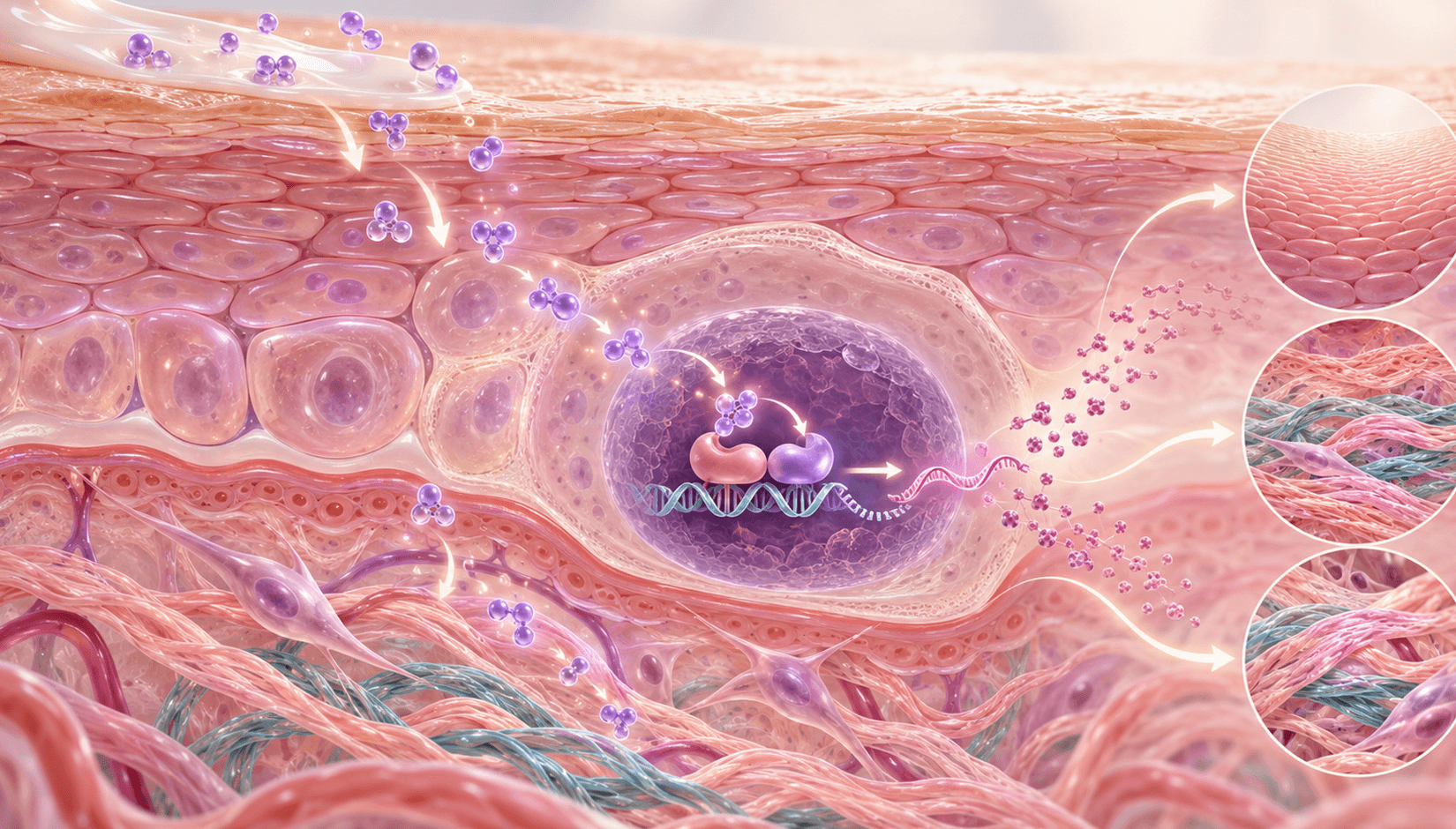
Retinoic acid is where the familiar conversion sequence usually stops on the page. Inside the cell there is considerably more going on. Retinoic acid can interact with nuclear retinoic acid receptors, known as RARs, which work with retinoid X receptors, or RXRs. The resulting receptor complexes can bind to specific regions of DNA and alter the transcription of responsive genes. Those changes reach processes in both epidermal and dermal tissue, although they don’t all occur at the same time or translate directly into a visible change at the skin surface.
This is one reason the familiar skincare expression “increases cell turnover” needs some unpacking. Retinoid research describes effects involving keratinocyte proliferation and differentiation, epidermal changes and components of the dermal extracellular matrix. Compressing those processes into the image of old cells simply being replaced faster makes the mechanism sound more mechanical than it is.
The same care is useful with collagen. “Boosts collagen” is common consumer language, but collagen-related evidence may refer to different endpoints depending on the study. Histological changes after tretinoin, expression of procollagen markers in retinol research and a visible reduction in fine lines are related observations, but they don’t measure the same thing. A product claim becomes much easier to judge once the type of evidence behind it is kept visible.
For a cosmetic retinoid, all of this comes after another practical hurdle. The molecule has to remain sufficiently stable in the formulation and be delivered to the skin in a usable form. Retinoids are lipophilic, and their instability has prompted research into lipid nanoparticles, nanoemulsions, nanocapsules and other delivery approaches intended to reduce degradation or alter release8. Whether a particular commercial product gains those advantages depends on the actual delivery system and finished formula. The word “encapsulated” on its own doesn’t supply that information.
Why retinoids can change the appearance of photoaged skin
Photoaging involves changes at several levels of the skin. Chronic ultraviolet exposure affects pigmentation, epidermal organisation and the dermal extracellular matrix, including collagen. Clinical retinoid studies therefore tend to measure a mixture of outcomes such as fine lines, wrinkles, mottled pigmentation, texture and overall photodamage rather than one universal marker of “anti-ageing” activity.
Retinoic acid has the deepest clinical history within the family, while the literature for cosmetic retinoids is smaller and more dependent on particular formulations. At the same time, cosmetic retinoids aren’t supported only by laboratory mechanisms. Human studies exist for retinol and retinal formulations, including controlled trials using instrumental, clinical and in some cases histological measurements 3, 4, 5, 6.
When a cosmetic promises to improve wrinkles, texture or uneven pigmentation, then, the useful questions become quite specific. Which retinoid was studied? At what concentration? Was the research performed on the raw ingredient or the finished formula? How long was it used, what was it compared with, and which outcomes were actually measured? Keeping those details attached to the claim produces a less tidy answer than “retinoids work”, but it also tells us far more about the product in front of us.
References
- Mambwe B, Mellody KT, Kiss O, et al. Cosmetic retinoid use in photoaged skin: A review of the compounds, their use and mechanisms of action. International Journal of Cosmetic Science. 2025;47(1):45-57. DOI 10.1111/ics.13013
- European Commission. Commission Regulation (EU) 2024/996 of 3 April 2024, amending Regulation (EC) No 1223/2009 regarding vitamin A and other substances in cosmetic products
- Randhawa M, Rossetti D, Leyden JJ, et al. One-year topical stabilized retinol treatment improves photodamaged skin in a double-blind, vehicle-controlled trial. Journal of Drugs in Dermatology. 2015;14(3):271-280
- A stabilized 0.1% retinol facial moisturizer improves the appearance of photodamaged skin in an eight-week, double-blind, vehicle-controlled study. PubMed PMID 19852122.
- Efficacy and tolerability of topical 0.1% stabilized bioactive retinol for photoaging: A vehicle-controlled integrated analysis. Journal of Drugs in Dermatology. 2024;23(4). DOI 10.36849/JDD.8124
- Kwon HS, Lee JH, Kim GM, Bae JM. Efficacy and safety of retinaldehyde 0.1% and 0.05% creams used to treat photoaged skin: A randomized double-blind controlled trial. Journal of Cosmetic Dermatology. 2018;17(3):471-476. DOI 10.1111/jocd.12551
- The efficacy and safety of multilamellar vesicle containing retinaldehyde: A double-blinded, randomized, split-face controlled study. PubMed PMID 33569865
- Lipid nanoparticles for the topical delivery of retinoids and derivatives. PubMed PMID 25600970. DOI 10.2217/nnm.14.159