
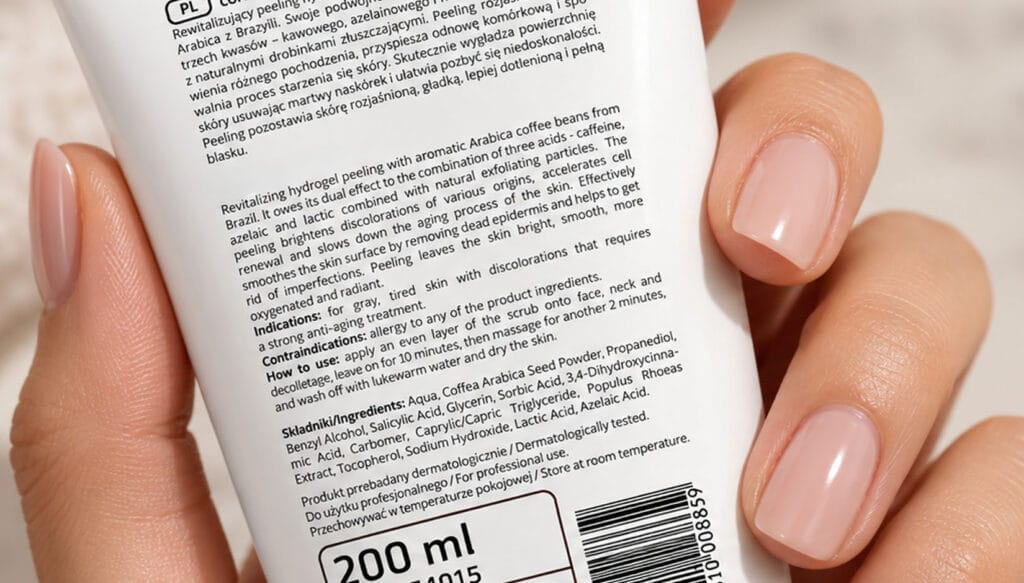
Flip the skincare bottle around and find phenoxyethanol somewhere in the latter half of the ingredient list. If you’ve done your share of researching about cosmetic advice online, you’re already aware of the next part of the exercise, draw a mental line above phenoxyethanol and assume everything below it is present at less than 1%. The guess might put you somewhere in the general vicinity of the actual answer. The trouble starts when the guess silently morphs into a measurement. There’s no 1% line printed in the ingredient list, and the regulations governing ingredient declaration allow for enough leeway that, in many cases, that exact line can’t be recovered from the label alone.
The 1% rule is still a handy tool. It explains why the front of the ingredient list conveys different information from the back, why compliant ingredient lists may arrange low-concentration ingredients in different orders and why order becomes harder to interpret further down the pack. To use that information effectively, however, we need to take a closer look at what the 1% rule actually means. If you need the bigger picture first, check out our guide on how to read a cosmetic ingredient list. Here, we’re focusing on one small percentage that has huge consequences for the way we read cosmetic ingredient lists.
What the 1% rule actually says
There is no universally applicable international cosmetic labelling law called “the 1% rule“. The phrase is a handy simplification of some of the requirements in ingredient-labelling regulations, and the exact wording is important, because cosmetics sold in different markets don’t necessarily follow identical rules.
The rule in the European Union
According to Article 19 of Regulation (EC) No 1223/2009 on cosmetic products, the ingredient list shall be presented in descending order of weight at the time of adding the ingredients to the cosmetic product. Ingredients present at concentrations below 1% may then be listed in any order after those present at concentrations above 1%.1
That wording gives us two zones that contain different amount of ordering information. Above the threshold, the ingredient weight determines the sequence. Below 1%, ingredient positions may stop following concentration.
There are additional twists around the edges. The colourants (except those used to colour hair) may be listed in any order after the other cosmetic ingredients. The decorative cosmetics available in several shades may also employ the familiar “may contain” or “+/-” convention for colourants common across the range.1 Without even considering the process of reconstruction, the product category itself plays a role.
The US rule is slightly different
According to FDA ingredient labelling rules, ingredients should be listed in descending order of predominance. Ingredients present at concentrations of 1% or less may be listed without regard to predominance after the ingredients present at more than 1%, while colour additives are governed by additional rules2
Read carefully and notice a slight difference from the wording of the EU rule. While the EU regulation refers to ingredients below 1% and ingredients above 1%, the FDA rule specifically mentions ingredients at 1% or less as part of the flexible group. In the course of everyday discussions, both rules get conveniently reduced to “everything below 1% can be listed in any order”, which is good as a rough explanation but misses one regulatory detail once the rule starts being applied precisely.
The FDA Cosmetics Labeling Guide includes an illustrative example of a pressed powder. After taking care of the ingredients present at more than 1%, ingredients present at 1% or less can be listed according to the rule’s flexibility.3 The actual formula is known in the example, so percentages are revealed there. What the shopper holds in her hands is just the ingredient declaration resulting from the formula.
Why you can’t see where 1% starts
Imagine a simple moisturiser with an ingredient list ending like this:
Aqua, Glycerin, Caprylic/Capric Triglyceride, Cetearyl Alcohol, Propanediol, Glyceryl Stearate, Niacinamide, Squalane, Phenoxyethanol, Panthenol, Carbomer, Ethylhexylglycerin, Sodium Hyaluronate, Tocopherol.
There is no punctuation change at the point where the low-concentration ingredients begin, no “<1%” heading and no typographical hint of a border. The list simply goes on.
Let’s say that phenoxyethanol is present at 0.8%. It would be easy to set the boundary just before it. However, that wouldn’t determine whether squalane is at 1.4%, 1.05% or 0.7%. If squalane is also below 1%, its position relative to phenoxyethanol is allowed by the flexibility of the rule. Depending on the actual formula and the market where the label applies, several other ingredients could also be a part of that low-concentration group.
There is also one possible variation, often missed in online explanations – the manufacturer may decide to maintain the descending order even where the regulation allows more freedom. Right to arrange the low-concentration group in any order doesn’t create an obligation to arrange it in any order. An ingredient list that is ordered all the way down to the last ingredient may therefore contain the flexible zone where the order happens to reflect concentration. What we can see on the pack is the order chosen for the declaration. The manufacturer has the quantitative formula behind it. These are different layers of information.
Ingredient order and concentration are different kinds of information
At the top of a standard EU ingredient list, the ordering allows us to make relative comparisons. If glycerin appears before an oil and both are above 1%, glycerin was added to the formula in greater weight than that oil. The size of the gap is unknown, though. A formula containing 12% glycerin followed by 3% oil and another formula containing 5% glycerin followed by 4.8% oil will preserve the same order.
This limitation becomes stricter after the flexible-order rule starts applying. If panthenol appears before sodium hyaluronate in this part of the list, the positions alone can hardly tell us anything about which one of them is at the higher concentration.
This is why trying to read an ingredient list as if every step downwards corresponded to a predictable decrease in percentage quickly becomes unreliable. Ingredient order is relative information under certain conditions. Concentration is quantitative information, and the label doesn’t normally contain the numbers we would need to translate one into the other.
There are methods to get more information once a brand publishes percentages or technical documents on their formula. That question exceeds the scope of the 1% rule and will be explored separately when discussing how exactly ingredient concentration can be determined from an INCI list.
Can phenoxyethanol reveal the 1% line?
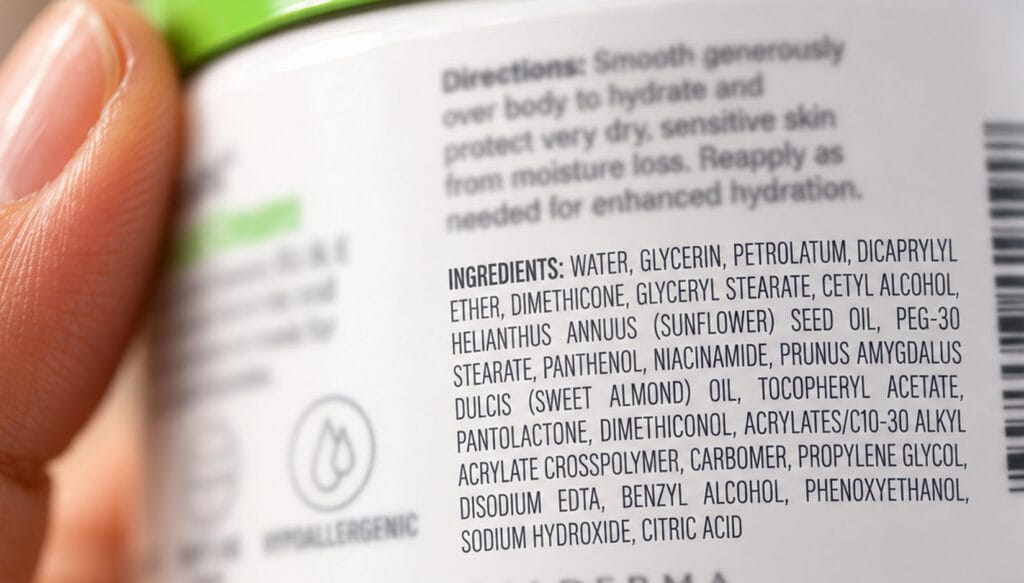
Phenoxyethanol has become the internet’s favourite reference point for the exercise for a good reason. In the EU, it is an authorised preservative with maximum concentration of 1% in the ready-to-use preparation. According to the Scientific Committee on Consumer Safety of the European Commission, 2-phenoxyethanol is safe for use as a preservative at a maximum concentration of 1.0%.4
When phenoxyethanol is found in an EU cosmetic and is used as the preservative limited in this way, we therefore have a nice regulatory context. It can’t just appear at 2% or 3%. This narrows the possibilities around its position considerably.
It still doesn’t print the missing boundary for us.
Consider this short tail:
… Cetearyl Alcohol, Squalane, Phenoxyethanol, Panthenol, Xanthan Gum, Sodium Hyaluronate, Ethylhexylglycerin.
Phenoxyethanol may well belong to the low-concentration zone. Panthenol, xanthan gum and sodium hyaluronate may be in that zone too. What about squalane? Its position right before phenoxyethanol doesn’t guarantee that it crosses 1%. Several ingredients in this section may be below the limit, and their order can be arranged without concentration defining each position.
There is also a formulation detail lurking behind most preservatives’ names. Cosmetic manufacturers often purchase preservatives as pre-blended commercial preparations. For instance, Ashland’s euxyl PE 9010 is based on Phenoxyethanol and Ethylhexylglycerin and has a recommended use level of 0.5–1.0%.5 The use level of the preservative system refers to the percentage of the preservative product used in the formula. It doesn’t guarantee that the concentration of each individual ingredient contained in that preparation is equal to the preservative system’s use level.
Reading “the preservative system is used at 1%” and translating it into “phenoxyethanol is present at 1%” skips a step. The concentration of a raw ingredient, the use level of a commercial preparation and the concentration of an individual ingredient in the finished cosmetic are three different numbers.
Other ingredients used to hunt for the 1% boundary
Once you’re familiar with the phenoxyethanol shortcut, it’s easy to extend the technique. Carbomer seems like a nice marker. Xanthan gum is nice too. Disodium EDTA often appears at the end of lists. Citric acid and sodium hydroxide are used in small quantities. Fragrances are attractive because skincare face products usually have less of it than a fine fragrance. All of these can provide some context. None of them carries the “1% starts here” instruction in its INCI name.
Carbomer and other rheology modifiers
Carbomer gives us a useful example because its job can require surprisingly little material. Lubrizol lists a recommended use level of 0.1–0.6% for Carbopol 934 polymer, whose INCI name is Carbomer, and describes it as a rheology modifier, suspending agent and thickener.6 If Carbomer appears near the bottom of a moisturiser, knowing how this type of polymer is commonly formulated can make a sub-1% concentration quite plausible. The ingredient list hasn’t told us which commercial polymer grade was used, however, and a supplier recommendation for one Carbopol grade isn’t a universal concentration rule for every material declared as Carbomer. Xanthan gum presents a similar interpretive problem. Seeing it low in the list can fit perfectly well with the way a formula is built, while the observation remains formulation context rather than a measurement extracted from the label.
EDTA and pH adjusters
Chelating agents such as Disodium EDTA also attract boundary hunters because they are often used at comparatively low levels. Then there are ingredients such as citric acid, sodium hydroxide or other materials used to adjust pH, where the amount needed can depend on the system being adjusted and what happened during manufacture.
This is where ingredient-list detective work needs some restraint. Knowing that a material is commonly used at a low concentration can make one interpretation more plausible. It can’t supply the missing formula. The amount of a pH adjuster needed in one product may differ from another because the formulas being adjusted are different in the first place.
Parfum can make the shortcut wobble even more
Fragrance deserves particular care because Parfum or Fragrance represents a composition rather than a single molecule whose position conveniently gives away everything around it.
The concentration of a fragrance mixture also depends heavily on the product. A lightly fragranced face cream, a body product and a fine fragrance operate on very different scales. Meanwhile, restrictions on individual fragrance materials operate at another level. IFRA explains that quantitative limits in its Standards are expressed as the upper concentration of the relevant fragrance material in the finished consumer product.7 That figure shouldn’t be confused with the concentration of the complete fragrance mixture.
EU labels are becoming more interesting in this area as well. Commission Regulation (EU) 2023/1545 expanded the individual labelling requirements for fragrance allergens. The transition is particularly visible in 2026: products complying with the previous requirements could continue to be placed on the EU market until 31 July 2026, while products covered by the transitional arrangements can continue to be made available until 31 July 2028.8
For our purposes, the important detail is fairly simple. Names appearing around Parfum may be there because of specific fragrance-allergen declaration requirements as well as the broader structure of the formula. Treating the word Parfum as a ruler laid across every cosmetic ingredient list loses too much context.
What happens inside the flexible part of the list
Take a hypothetical EU formula in which the first six ingredients are above 1% and the remaining five are all below it:
Aqua, Glycerin, Propanediol, Caprylic/Capric Triglyceride, Cetearyl Alcohol, Glyceryl Stearate, Phenoxyethanol, Panthenol, Xanthan Gum, Sodium Hyaluronate, Tocopherol.
Now imagine that the same low-concentration ingredients appear this way:
Aqua, Glycerin, Propanediol, Caprylic/Capric Triglyceride, Cetearyl Alcohol, Glyceryl Stearate, Sodium Hyaluronate, Tocopherol, Phenoxyethanol, Xanthan Gum, Panthenol.
Assuming those five ingredients genuinely fall below 1%, both arrangements can fit the EU ordering provision.1 The change in sequence doesn’t require a change in their concentrations. Someone comparing the two lists without knowing that could easily read a formulation story into the rearrangement: the first seems to give panthenol greater prominence, while the second pushes sodium hyaluronate much higher.
That apparent movement is one reason reformulation claims based solely on small positional changes near the bottom of an INCI deserve checking. If an ingredient moves from twelfth to ninth, concentration may have changed. The low-concentration group may also have been reordered, or other ingredients may have been added or removed around it. Before assigning a cause, we’d need more evidence.
There is an equally important reverse case. Ingredients below 1% may be placed in a more flexible order under EU rules, but they can still remain in descending order. Looking at a neat sequence gives us no visual signal telling us which option was chosen.
An ingredient can matter at much less than 1%
The 1% discussion sometimes drifts into another shortcut: once an ingredient is suspected to sit below the line, it gets treated as decorative or too diluted to do anything useful. Formulation doesn’t give us a common concentration scale on which every ingredient becomes meaningful at the same number.
Carbomer makes the problem obvious. A rheology modifier recommended at 0.1–0.6% can materially change viscosity, suspension and the physical behaviour of an emulsion while occupying a tiny fraction of the finished product.6 A preservative system has a different job, and a pH adjuster can be present in a small quantity because only a small quantity was needed to bring the formula into its intended pH range.
With skincare actives the question becomes more complicated, because useful concentration depends on the particular substance, the form in which it is supplied, the finished formulation and what the product is claiming to achieve. Seeing an active below a suspected 1% boundary can be relevant information, especially when a specific claim makes concentration important. Its position alone leaves too many pieces of the formulation unknown to settle the question of efficacy.
There is another wrinkle here that becomes easy to miss when reading raw INCI lists. Formulators work with raw materials, and those materials aren’t always 100% of the ingredient consumers recognise by name. A solution, dispersion, botanical extract or premix can contain a carrier, solvent and functional material in proportions specified by its supplier. If a brand tells us that it uses 2% of a commercial raw material, that doesn’t automatically establish a 2% concentration for every INCI component contributed by that material.
Where online 1% detective work goes wrong
The appealing part of the 1% trick is that it appears to turn an opaque ingredient list into numbers. Find phenoxyethanol, locate the boundary, estimate everything around it. Once those estimates are repeated across reviews and social posts, the qualifiers tend to disappear.
A claim such as “niacinamide appears below phenoxyethanol, therefore this formula contains less than 1% niacinamide” may occasionally be supported by additional information, but the sequence alone can leave more than one compliant explanation. The uncertainty becomes larger if phenoxyethanol itself has been treated as the exact start of the flexible group without evidence that the preceding ingredient sits above the threshold.
Another common leap goes from position to a surprisingly precise range. An ingredient might be described as “probably around 0.3–0.5%” because it sits between two materials with familiar use levels. That can be a useful formulation hypothesis when someone is analysing a formula professionally and has several independent constraints to work with. On a consumer ingredient list, the precision often comes from assumptions that the pack itself never supplied.
Then there are comparisons between products. Suppose serum A places an ingredient eighth and serum B places it twelfth. If both positions lie inside flexibly ordered groups, the ranking tells us very little about which serum contains more. Even when one or both positions sit above 1%, knowing the neighbours still doesn’t automatically reveal the ingredient’s exact percentage.
Perhaps the most persistent problem is treating a typical use range as though it were the formula. Supplier documentation can tell us how a raw material is recommended for use, regulatory annexes can give us maximum permitted concentrations for certain substances, and published formulations can show how an ingredient behaves in real examples. These are valuable pieces of evidence, although each answers its own question. None quietly turns an undisclosed commercial formula into a disclosed one.
Three ingredient lists and three different reading problems
A moisturiser with phenoxyethanol in the middle
Consider:
Aqua, Glycerin, Caprylic/Capric Triglyceride, Cetearyl Alcohol, Butyrospermum Parkii Butter, Niacinamide, Glyceryl Stearate, Squalane, Phenoxyethanol, Panthenol, Carbomer, Ethylhexylglycerin, Tocopherol.
For an EU product, phenoxyethanol’s regulatory maximum as a preservative gives us a strong reason to place it at or below 1%.4 We can also recognise Carbomer and Ethylhexylglycerin as ingredients that fit comfortably into low-use portions of many formulas.
The interesting uncertainty sits just above phenoxyethanol. Squalane could be above 1%. It could also belong to the flexible group. The same question can extend farther upward depending on the actual concentrations. Drawing a hard line between Squalane and Phenoxyethanol makes the label look more informative than it is.
A gel serum where a tiny amount can do a lot
Now take:
Aqua, Propanediol, Glycerin, Betaine, Panthenol, Hydroxyethylcellulose, Sodium Hyaluronate, Carbomer, Arginine, Disodium EDTA.
There is no phenoxyethanol to use as a convenient landmark. Carbomer appears eighth, yet supplier documentation shows that at least some cosmetic Carbomer grades are designed to work at fractions of a percent.6 Hydroxyethylcellulose introduces another rheology-related ingredient earlier in the list. Trying to assign percentages from position alone would require assumptions about the thickening system, raw materials and the ordering choices made for the declaration.
What the list gives us is still useful. We can see which ingredients are declared, obtain ordering information where the descending-order requirement applies and, with some formulation knowledge, recognise the broad architecture of the product. It simply stops short of giving us the quantitative formula.
A fragranced formula with a busier tail
A body product might finish with something along these lines:
… Cetearyl Alcohol, Glyceryl Stearate, Parfum, Phenoxyethanol, Carbomer, Limonene, Linalool, Citric Acid, Sodium Hydroxide.
Here, several systems overlap. We have the cosmetic formula, a fragrance composition represented by Parfum, individually declared fragrance allergens where applicable, preservation, rheology and pH adjustment. A reader who simply places the 1% boundary at Parfum or phenoxyethanol and then interprets every subsequent position as a concentration ranking will miss why some of those names appear on the label in the first place.
As EU fragrance-allergen labelling moves through its current transition, reading this part of the ingredient list also requires attention to the applicable labelling requirements.8 The bottom of an INCI can look deceptively simple while several regulatory and formulation decisions are sitting underneath it.
Colour cosmetics need another layer of caution
Foundation, lipstick, eyeshadow and other colour cosmetics expose one of the weaknesses of applying skincare heuristics everywhere. Both EU and US rules provide special flexibility for colourants, although the precise regulatory framework and presentation differ.12
The FDA’s pressed-powder example makes the issue unusually tangible. Colour additives can be declared according to specific provisions that prevent the ingredient list from functioning as a simple descending concentration chart.3 A colourant sitting near the end of a makeup list therefore can’t be assigned a trace concentration merely from its visual position.
Multi-shade products add another practical complication. In the EU, decorative cosmetics marketed in several shades may list colourants used across the range with “may contain” or “+/-”.1 The ingredient list on one box can consequently describe possibilities across shades instead of functioning as a quantitative map of the exact pigment mixture in the shade you’re holding.
What would actually tell us the percentage?
If a brand says that a serum contains 5% niacinamide, we now have a quantitative claim that exists outside the ordinary positional information supplied by the ingredient list. The next question is where that figure comes from and exactly what it describes.
Brand documentation can provide declared concentrations. Supplier technical documents can identify the composition and recommended use of a raw material. Patents sometimes reveal formula ranges or examples, although connecting a patent example to the commercial product on a shelf requires care. Scientific papers can tell us about concentrations tested under particular conditions. Regulatory documents may establish maximum or minimum concentrations for certain regulated substances.
Each source needs to be read for the question it can actually answer. A regulatory maximum gives us the ceiling permitted for a specified use. It doesn’t establish that every product uses the ingredient at that ceiling. A supplier’s recommended range describes its material and intended applications; it doesn’t disclose what an unrelated manufacturer chose for a particular product. A clinical study using one concentration doesn’t establish the concentration of every cosmetic carrying the same ingredient.
This is where the BeautyLookup habit of following the claim back to the paperwork becomes useful. Sometimes the trail reaches a clear percentage. Sometimes it reaches a range, a regulatory ceiling or a commercial raw material with its own composition. And sometimes the public documentation simply runs out before the number we wanted appears.
A practical way to use the 1% rule
When you’re reading an ingredient list, treat the 1% threshold as a change in how much information the order can give you. Near the top of the list, position is generally more useful for comparing relative amounts. Further down, ingredients such as phenoxyethanol, carbomer, gums, chelating agents or pH adjusters can help you recognise that you may be approaching the low-concentration part of the formula, although none of them reliably marks its exact beginning.
If an ingredient sits low on the list, avoid assigning it a percentage from position alone. Check whether it has a regulatory concentration limit, whether supplier documentation gives realistic use levels, whether the brand discloses a percentage and whether you’re looking at an individual ingredient or one component of a commercial blend. Once several ingredients could fall within the flexible-order group, comparing their positions becomes increasingly uncertain.
If the question you’re trying to answer is whether an ingredient is present at an effective concentration, the ingredient list may only get you part of the way there. At that point, useful evidence moves beyond its position on the pack and into the formulation, the product’s supporting documentation and the evidence for that particular ingredient and use.
How far can you reasonably read an ingredient list?
Go back to that bottle with phenoxyethanol halfway down the list. After looking at the regulation, we can read it with more information than we had at the start. In an EU cosmetic, phenoxyethanol used as a preservative is limited to 1%. Nearby Carbomer may plausibly be used at a fraction of a percent. Ingredients in the low-concentration region may have been arranged without following their relative amounts, while the manufacturer may also have chosen to preserve descending order. The precise boundary still isn’t printed anywhere.
That leaves plenty of legitimate information on the pack. We can identify ingredients, examine the architecture of the formula, use regulatory limits where they genuinely apply and recognise when a low position is consistent with the way a particular material is normally formulated. With two versions of a product in hand, we can also spot additions, removals and substantial changes in the list, while being more careful about what a small movement near the bottom proves.
Once the question changes from “where is this ingredient listed?” to “exactly how much is in here?”, the evidence has changed too. Sometimes the answer is available elsewhere in the product documentation. Sometimes formulation knowledge lets us narrow the possibilities. In other cases, the most accurate reading of the ingredient list ends with several possibilities still open, which is exactly what the labelling rules allow.
References
- European Parliament and Council. Regulation (EC) No 1223/2009 on cosmetic products, Article 19
- Electronic Code of Federal Regulations. 21 CFR § 701.3, Designation of ingredients
- US Food and Drug Administration. Cosmetics Labeling Guide
- Scientific Committee on Consumer Safety, European Commission. Opinion on Phenoxyethanol
- Ashland. euxyl PE 9010 preservative
- Lubrizol. Carbopol 934 polymer
- International Fragrance Association. Using the IFRA Standards
- European Commission. Commission Regulation (EU) 2023/1545 on the labelling of fragrance allergens in cosmetic products